

Wood vs Cardboard Displays: Why Wood Wins for Irish Retailers in 2026
Wooden displays sell better, last longer and make your brand look the part. Cardboard units look cheap on the first invoice, but they sag, scuff and end up in the skip after one campaign, and then you buy the next one, and the one after that. For Irish retailers and the brands that supply them, 2026 adds even more reasons to choose wood: EU packaging law, strict new rules on green claims and shoppers who notice a tired display. Here is why we build in wood, and why it pays.

Key takeaways
- Wood wins on lifespan, strength, shelf presence and cost over time. Cardboard only looks cheaper because you keep buying it again.
- A wooden display can be restocked and re-themed season after season; most cardboard units are binned after one campaign.
- The EU Packaging and Packaging Waste Regulation has applied since 12 August 2026 and adds pressure on single-use packaging.
- Since 27 September 2026, vague claims like "eco-friendly" are banned in Ireland unless you can prove them. Use specific facts instead.
- From 30 December 2026, the EU Deforestation Regulation requires large and medium operators to show timber comes from deforestation-free sources.
Wood vs cardboard displays: the side-by-side
| Cardboard | Wood | |
|---|---|---|
| Lifespan | Weeks to a few months | Years, with restocking |
| Strength | Sags under weight, damaged by spills and mopping | Carries bottles, jars and heavy packs |
| Look in store | Temporary, and it looks tired within weeks | Premium, permanent, specialist |
| Branding | Full-colour print, reprinted each campaign | Engraved or printed, plus swappable header boards |
| Best for | A one-off event you are happy to bin afterwards | Launches, promotions, core ranges and premium brands: anything you want selling for more than a few weeks |
| End of life | Recycled after one use – if it is clean and dry | Re-used, re-themed or moved to another store |
Why cardboard costs more than it looks
Cardboard is sold on speed and a low price per unit. But every cardboard unit is a repeat cost: printing, freight, assembly and disposal, campaign after campaign. It sags under bottles and jars, soaks up spills and mop water, and starts to look worn just when your promotion needs it most. A worn display tells shoppers the product is an afterthought.
Even for a short launch, wood is the better buy. A wooden unit with a swappable header board runs the launch, then carries the core range for years. Engrave your logo once and it is on the shop floor every day, not just for a fortnight.

What about plastic and acrylic?
Plastic and acrylic stands are sold as durable, but they scratch, cloud and yellow under shop lighting, and they rarely look premium next to real products. They are made from fossil-based materials and are hard to recycle at the end. Wood is warm, strong and repairable: it can be sanded, re-stained, re-printed and re-branded, and it suits food, drink, gifts, beauty and fashion alike. Read more in Greenwashing at the point of sale.
When wood pays its way
For a core range that stays on the shop floor, wood usually works out better. One unit restocked for years replaces a stream of cardboard units that each need printing, shipping, assembling and disposing of. Irish food and drink brands chasing a listing in an independent or a symbol-group store also get a premium, permanent presence that a sagging cardboard unit cannot match.
 Wooden FSDU Floor Display Stand P1 – Liffey
Made to order in Ireland, brandable
View product →
 Free-Standing Display Unit – Flexi 600
65 × 29 × 165 cm
View product →
 Adjustable Floor Display Unit – Arbor 600
60 × 38 × 160 cm
View product →
Case studies: brands that moved to wood
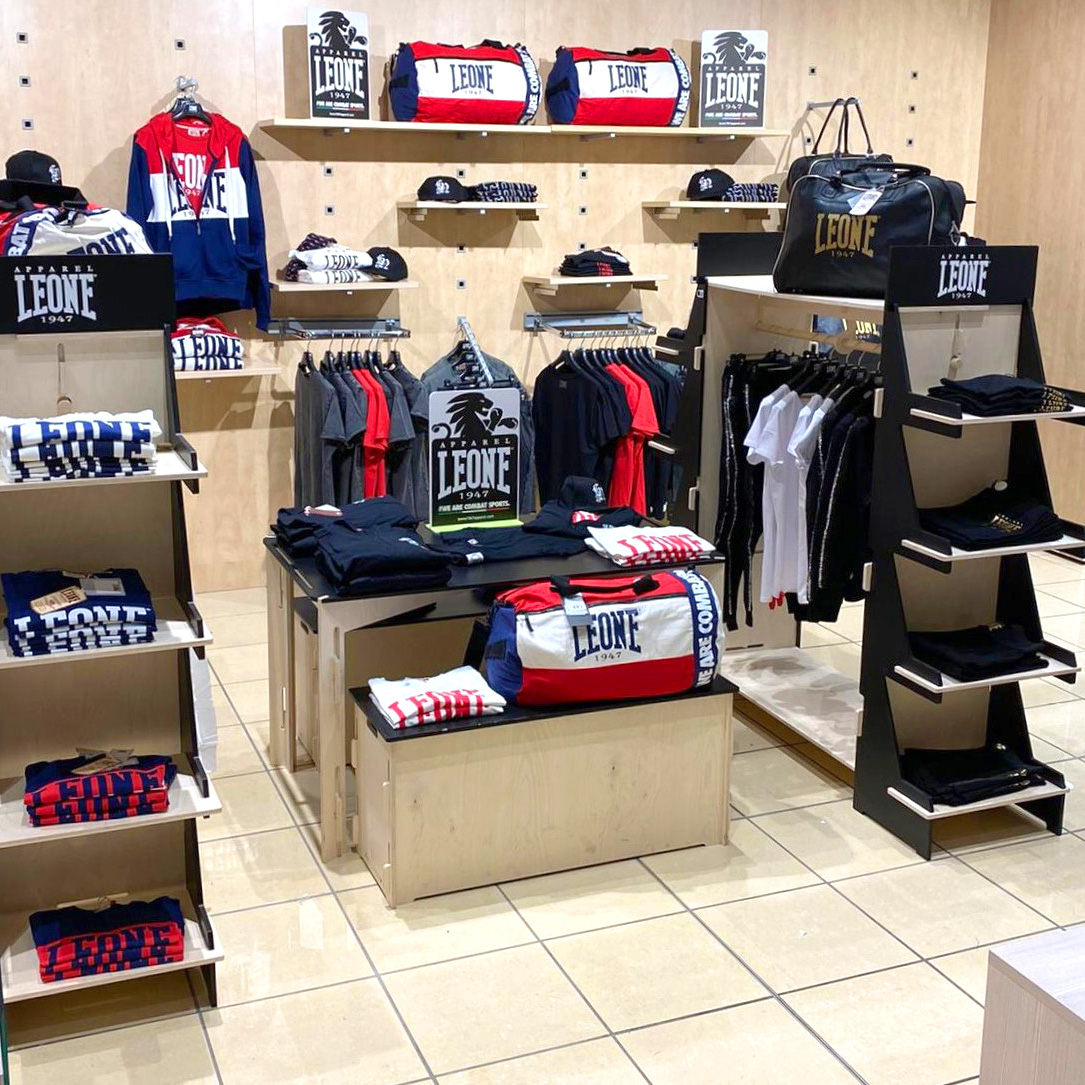
Leone Apparel 1947: from heavy metal to timber
The historic sportswear brand wanted to swap heavy metal fixtures for something lighter for a promotion in shops and shopping centres. ESPOSIT designed complete wooden display corners to fit an island of just 250 × 250 cm. The whole set shipped on a single pallet and was assembled by shop staff – no fit-out crew.

Liix: a two-metre stand that ships on one pallet
The German bicycle-accessory brand needed a floor display of about 1.95 metres with 40 hooks for hundreds of small products. A one-piece unit that tall means oversized freight. ESPOSIT's answer was a modular stand that splits into sections no bigger than one metre, interlocks in store and travels flat-packed on a single standard pallet.
Built in Dublin: branded FSDUs for Irish brands
Our own workshop builds free-standing units for drinks and snack brands such as Jump Juice – permanent, branded and built to be restocked rather than replaced.


Modular or bespoke?
Wood does not have to mean made-to-order. ESPOSIT's catalogue runs to more than a hundred models, many of them modular, so a unit can be extended or reconfigured when your range changes. Bespoke earns its place when the brand, the space or the product is unusual. Start modular; go bespoke when the brief demands it.
What changed in 2026: three EU rules to know
1. Packaging and Packaging Waste Regulation (from 12 August 2026)
The PPWR replaces the old packaging directive with one regulation that applies directly in Ireland. It tightens rules on packaging design, recyclability and waste, and pushes the supply chain away from single-use formats. Shelf-ready and display packaging is part of that conversation. A permanent wooden display, by contrast, is shop furniture.
2. Green claims rules (from 27 September 2026)
Ireland's European Union (Empowering Consumers for the Green Transition) Regulations 2026 ban generic environmental claims such as "eco-friendly" or "green" unless the trader can prove recognised excellent environmental performance. Sustainability labels must be certified or set up by a public body. If you promote your display – or your products – on environmental grounds, use specific, provable facts: the material, where it was made, how long it lasts, whether it is certified.
3. EU Deforestation Regulation (from 30 December 2026)
Large and medium operators placing timber products on the EU market must carry out due diligence to show the wood is legal and deforestation-free. If you buy wooden displays, ask your supplier where the timber comes from and how they comply.
Five questions to ask before you choose
- How long will the display be on the shop floor?
- How heavy is the product, and will it be chilled, wet or handled a lot?
- Will the message change, or just the stock?
- Who assembles it, and how often will it move?
- What happens to it at the end?
In almost every case, the answers point to wood. Tell us about your range and we will design a branded wooden display that fits it.
FAQ
Are wooden displays more expensive than cardboard?
Only on the first invoice. A wooden unit that is restocked and re-branded for years replaces many cardboard units, each one printed, shipped, assembled and binned. Over any listing longer than a few weeks, wood usually works out cheaper, and it sells better while it is there.
Can a wooden display be re-branded for a new campaign?
Yes. Swappable header boards and printed panels let you change the message without replacing the unit.
Can I call my display "eco-friendly"?
Not without proof under Ireland's 2026 green-claims rules. Describe the specific facts instead – for example, the type of wood, where it was made and how many seasons it is designed to last.
Can wooden displays be shipped flat?
Yes. Slot-together units like the ESPOSIT range travel flat-packed and assemble without tools, which keeps delivery simple even for tall floor units.
Ready to swap cardboard for something that lasts? Browse free-standing displays (FSDU), counter displays (CDU) or ask us for a branded quote.
Sources
- PwC Ireland – What the PPWR means for Irish businesses
- A&L Goodbody – August 2026 and beyond: the new EU packaging regulation in Ireland
- McCann FitzGerald – Empowering Consumers for the Green Transition Regulations 2026
- Matheson – Irish transposition of the Green Transition Directive
- Coolset – EUDR timeline tracker
- ESPOSIT – The project for Leone Apparel 1947
- ESPOSIT – The Liix case: logistical efficiency and flexible design
- ESPOSIT – Modular or customised displays?
This article is a practical summary, not legal advice.