

Green Claims Rules Ireland 2026: What Shops Can and Can't Say About 'Eco' Products
"Eco-friendly" has had its day. Since 27 September 2026, Irish shops can no longer stick vague green labels on products, shelf-edge cards or websites unless they can prove them. The new rules come from an EU directive, written into Irish law as the European Union (Empowering Consumers for the Green Transition) Regulations 2026, and they apply to every trader selling to consumers – the corner shop, the garden centre, the gift shop and the online store alike. Here is what changed, what you can still say, and how to tidy up your shop floor without losing the message.

Key takeaways
- The Regulations apply from 27 September 2026 to all traders selling to consumers in Ireland, in store and online.
- Generic claims such as "eco-friendly", "green" or "natural" are banned unless you can show recognised excellent environmental performance.
- Sustainability labels must come from a certification scheme or a public authority – home-made badges are out.
- "Carbon neutral" claims based on offsetting are banned.
- The CCPC enforces the rules. Widespread breaches can carry fines of up to 4% of turnover or €2 million.
Green claims rules in Ireland: what changed on 27 September 2026
The Regulations amend the Consumer Protection Act 2007 and the Consumer Rights Act 2022. They add new practices to the list that are banned in all circumstances – no case-by-case argument, no "but everyone says it". For retailers, the headline changes are:
- Generic environmental claims. Words like "eco-friendly", "green", "environmentally friendly" or "climate friendly" are banned unless the business can demonstrate recognised excellent environmental performance relevant to the claim.
- Sustainability labels. A label or badge must be based on a certification scheme or set up by a public authority. A leaf icon with "planet-friendly" in your own font no longer passes.
- Whole-product claims. You cannot suggest a benefit applies to the whole product, or the whole business, when it only applies to one part – recycled packaging does not make the contents "sustainable".
- Offsetting claims. "Carbon neutral" or "climate positive" claims that rely on buying offsets are banned.
- Future promises. Claims like "net zero by 2030" need a detailed, public, verifiable plan with measurable targets behind them.
- Durability and repair. Inaccurate information about how long a product lasts or whether it can be repaired is also banned.
Who enforces it?
The Competition and Consumer Protection Commission (CCPC). It can issue compliance notices and fixed payment notices, and it can go to court for prohibition orders. For widespread breaches across the EU, fines can reach 4% of turnover or €2 million.
Does this apply to my shop – or only to the brands?
Both. The rules apply to "traders", and a retailer that repeats a claim on a shelf talker, a window poster, a hanging sign or a product page is making that claim to consumers. If a supplier's packaging says "eco-friendly", that is mainly the brand's problem. If your own signage says "our eco range", it is yours.

The words to retire – and what to say instead
The fix is not to go quiet. It is to swap the slogan for a fact the customer can check.
| Retire | Say instead (only if true) |
|---|---|
| "Eco-friendly range" | "Refill range – bring your own container" |
| "Sustainable packaging" | "Packaging made from 80% recycled cardboard" |
| "Green gifts" | "Gifts made in Ireland" or "Gifts made from solid oak" |
| "Carbon neutral delivery" | Describe what you actually do, without the offsetting claim |
| Home-made leaf badge | The recognised certification logo the product actually carries |
A shop-floor audit in five steps
- Walk the shop with a notebook. Shelf-edge cards, wobblers, headers on display units, window vinyls, chalkboards, carrier bags, the till screen.
- Check the website and social posts. Product titles, category names ("eco collection"), banners and email sign-off lines.
- Ask suppliers for evidence. If you repeat their claim, keep the certificate or test report on file.
- Rewrite in facts. Material, origin, recycled content, certification, how long it lasts, whether it can be repaired.
- Brief the staff. What a team member says at the counter counts too.
Where displays come in
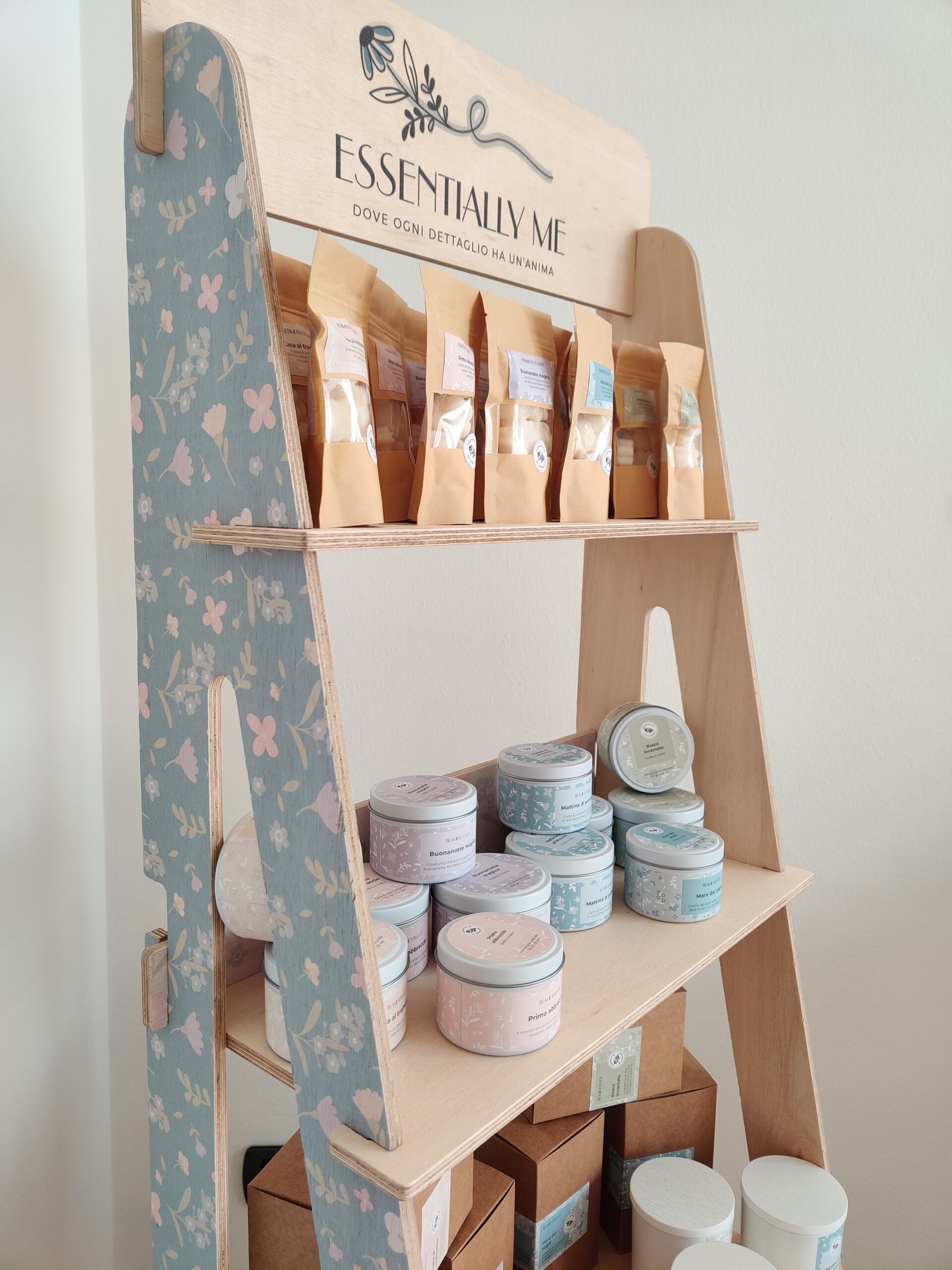
Display headers and fixture branding are prime territory for loose claims – "the natural choice", "kind to the planet". When you change the message, it helps if the fixture lets you change the header without replacing the unit. Wooden displays with swappable header boards, or a blank top panel you can re-letter, make a rules change a quick job rather than a refit.
It also pays to describe your fixtures honestly. A display made from solid timber, built in Dublin and designed to be restocked for years is a set of facts. "Eco display" is not.
 Natural Pine Crate-Style Countertop Display
Made in Dublin, header can be branded
View product →
 Retail Display Stand – Market 400
Tiered shelves for refill and loose ranges
View product →
 Adjustable Floor Display Unit – Adapti 400
Adjustable shelves, 40 × 35 × 160 cm
View product →
 Wooden FSDU Floor Display Stand P1 – Liffey
Bespoke, with a swappable header
View product →
Durability claims: the quiet change
The same Regulations also cover durability and repairability. If a sign says a product "lasts a lifetime" or "can be repaired", that needs to be accurate. For shop furniture and displays, stick to what the maker can stand over – materials, finish, care instructions and what parts can be replaced.
FAQ
Can I still call a product "natural"?
Be careful. Used as a general environmental claim, it falls into the same trap as "eco-friendly". Used as a factual description – "100% natural rubber", for example – and backed by the supplier, it is a different matter. Take advice if in doubt.
What about stock already printed with old claims?
The European Commission has published principles on old stock already on the market. Check the CCPC guidance and the Commission's notice, and update your own signage and website straight away – that part is fully in your control.
Does this apply to online shops?
Yes. The rules cover traders selling to EU consumers in store and online.
Can you change the branding on our existing displays?
Often, yes – new header boards, panels or engraving. Tell us what you have and we will suggest the simplest fix.
Sources
- CCPC – European Union (Empowering Consumers for the Green Transition) Regulations 2026
- Irish Statute Book – S.I. No. 124/2026
- Matheson – Irish transposition of the Green Transition Directive
- Beauchamps – Green Transition Regulations briefing
This article is a practical summary, not legal advice.