

General Product Safety Regulation: What Every Irish Shop Must Check Before It Sells
Every non-food product on your shelves now comes with a safety paper trail – and as the shop selling it, you are part of that trail. The EU General Product Safety Regulation (GPSR) has applied since 13 December 2024, written into Irish law by S.I. No. 726 of 2024 and enforced by the Competition and Consumer Protection Commission (CCPC). It reaches the gift shop, the hardware store, the pharmacy's front of shop, the toy shop and every Irish webshop selling to consumers. Most independents have never heard of it. Here is what it asks of you, in plain English, with a checklist you can use with your suppliers tomorrow.

Key takeaways
- The GPSR has applied since 13 December 2024. In Ireland, the CCPC enforces it.
- It covers consumer products that have no more specific EU safety rules – new, used, repaired and reconditioned goods, in store and online.
- As a retailer you are usually a "distributor". Before you sell, check the product carries the maker's details, an identifier and safety information.
- If you buy direct from outside the EU, or sell under your own brand, you may be the importer or manufacturer – with heavier duties.
- Online listings must show the manufacturer's contact details, a picture and product identification, and any warnings.
GPSR for Irish retailers: what it is and what it covers
The GPSR (Regulation (EU) 2023/988) replaced the old General Product Safety Directive. Its job is simple: only safe products should reach consumers, and every product should be traceable back to someone responsible for it.
It applies to consumer products that are not covered by more specific EU safety laws – think homewares, gifts, candles, stationery, clothing accessories, kitchenware, garden items and much more. It covers new, used, repaired and reconditioned goods, and it covers online offers aimed at consumers in the EU. It does not cover things like medicines, food and feed, plant protection products, antiques, or products clearly marked as needing repair before use.
A common misunderstanding
A CE mark is not proof that a product meets the GPSR. The CCPC is clear that CE marking should not be used to show GPSR compliance. CE marking relates to specific product laws, such as toys or electrical goods.
Which role are you? It changes everything
| If you… | You are probably… | What that means |
|---|---|---|
| Buy from an Irish or EU wholesaler or brand and resell | Distributor | Check before you sell; act if you suspect a problem |
| Buy direct from a maker outside the EU and bring it in | Importer | Check the maker's compliance, add your own details, keep records |
| Sell products under your own name or brand | Manufacturer | Full responsibility for safety, documents and labelling |
| Run a marketplace for other sellers | Online marketplace | Specific duties under the GPSR and the Digital Services Act |
One business can hold more than one role. A gift shop that resells Irish crafts and also imports its own-label candles from abroad is a distributor for the first and an importer – or manufacturer – for the second.
The distributor's checklist: before a product goes on the shelf
Most independent shops are distributors. Before you make a product available, check that:
- The product can be identified – a type, batch or serial number, or another identifier, on the product or its packaging.
- The manufacturer is named – name, registered trade name or brand, and postal and electronic address.
- The importer is named, if the product was made outside the EU.
- There is a responsible business in the EU for products from outside the EU, and its details appear on the product, its packaging, the parcel or an accompanying document.
- Instructions and safety information are included, in language consumers can easily understand.
And while it is in your care: store and handle it so its safety is not affected – no crushed packaging, no damp stockroom, no leaflets lost when you unpack for display.

When something is not right
If you think a product may be unsafe, or the required information is missing:
- Do not sell it until it is sorted.
- Tell the manufacturer or importer immediately.
- Make sure corrective action happens – a fix, a withdrawal or a recall.
- Notify the authorities through the EU's Safety Business Gateway where a product is dangerous.
- If you hear of an accident involving a product you sold, inform the manufacturer straight away.
If there is a recall
Customers who bought the product must be told directly, in writing and in plain language, where they can be identified. Where that is not possible, use the widest-reaching channels you have – website, social media, newsletter and an in-store notice. In a recall started by a business, customers must be offered at least two of these, free of charge: repair, replacement with a safe product of the same type and at least the same value and quality, or a refund of at least the price paid. A loyalty scheme or email list makes this far easier – one more reason to collect consent at the till.
Selling online? Your product pages need updating
For every product offered at a distance – your Shopify store, a marketplace listing, even a catalogue with an order form – the offer must clearly show:
- The manufacturer's name, registered trade name or brand, and postal and electronic address.
- For makers outside the EU, the name and contact details of the responsible business in the EU.
- Information that identifies the product – a picture, its type and any other identifier.
- Any warnings or safety information, in a language consumers can understand.
The quickest fix for most webshops is a standard "Product safety" block on every product page, filled from a supplier spreadsheet.
Second-hand, refurbished and craft sellers
Charity shops, vintage stores and refurbishers are not exempt: used and reconditioned products are in scope unless they are clearly sold as needing repair before use. Small makers selling their own work – candles, cosmetics, children's items – are manufacturers under the GPSR and carry the full responsibility. If that is you, check whether a more specific EU law also applies to your product.
Ten questions to send your suppliers
- Who is the manufacturer, and what are their postal and email addresses?
- Is there an EU importer or responsible business? Who?
- Where is the product identifier (batch, type or serial) on the product or pack?
- Are instructions and warnings supplied in English?
- Has a risk assessment been done for this product?
- Are any other EU rules relevant (toys, electrical, cosmetics, food contact)?
- How will you tell us about a safety issue or recall?
- Can you supply product safety text for our website listings?
- Do you have images showing the label and markings?
- Who is our contact for safety questions?
Displays and the shop floor
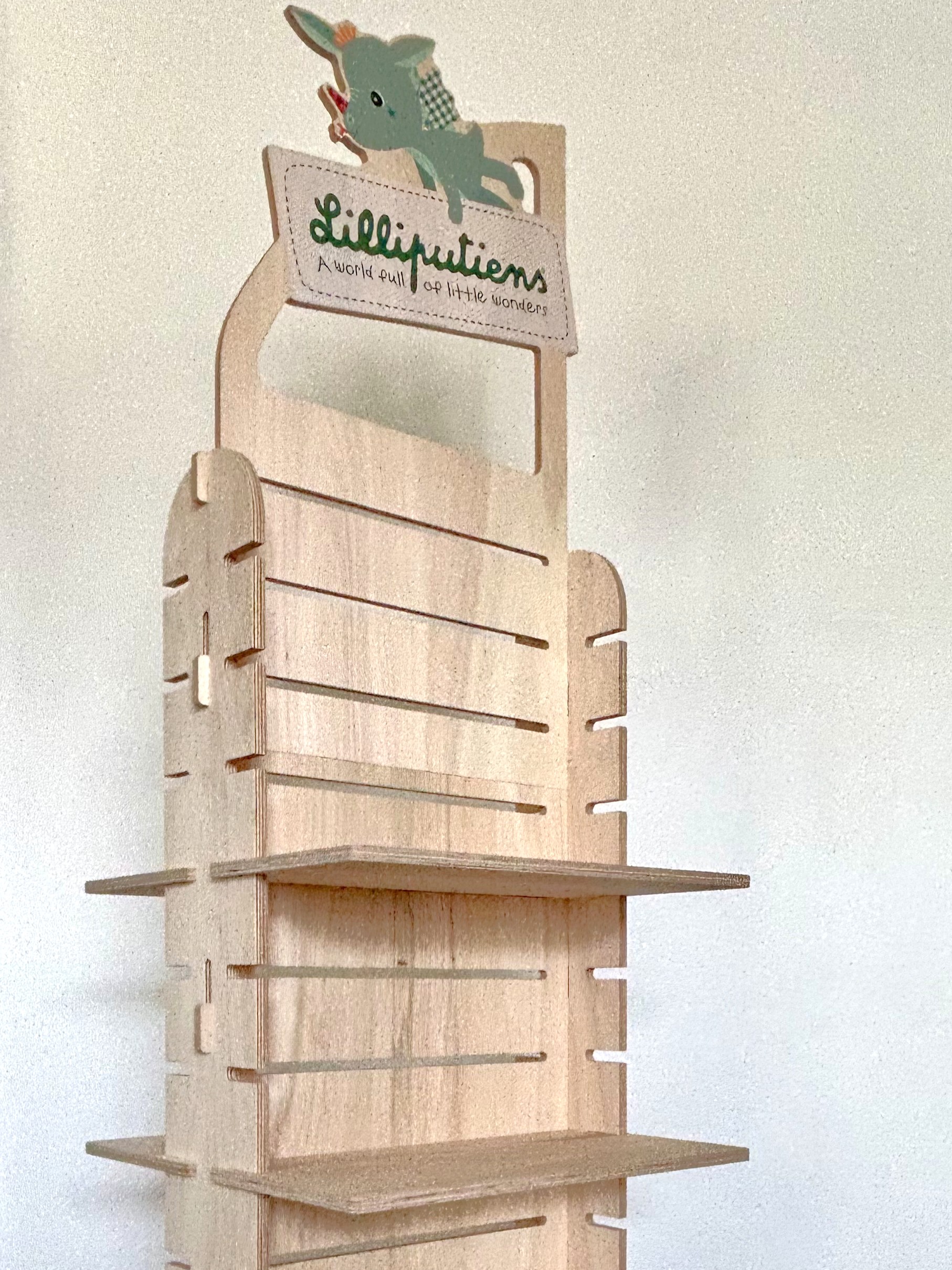
Good merchandising helps here. Keep products in their original packaging where the safety information lives, rather than stripping it for a neater shelf. Hook displays and adjustable shelving let you show the product and its label. Keep the instruction leaflets that come in outer cases. And keep a simple folder – paper or digital – with each supplier's details, so you can answer the CCPC, or a customer, in minutes.
 Rotating Countertop Display – Qub
Hooks keep labels facing out
View product →
 Adjustable Floor Display Unit – Adapti 400
Shelves for packs of every size
View product →
 Slim Greeting Card Display Stand – Iris
For cards, stationery and small gifts
View product →
 Free-Standing Display Unit – Flexi 400
Tilting shelves, 45 × 29 × 165 cm
View product →
Part of our guide to EU retail rules for Irish shops. See also Right to Repair for retailers and green claims rules.
FAQ
Does the GPSR apply to small shops?
Yes. There is no small-business exemption for distributors. The checks are simple, though, and mostly about asking suppliers the right questions.
Does it apply to second-hand goods?
Yes – used, repaired and reconditioned products are covered, except products clearly marked as needing repair or reconditioning before use. Antiques are excluded.
Do I need to change my product listings?
If you sell online to consumers, yes. Each listing must show the manufacturer's details, product identification and any warnings or safety information.
Who enforces the GPSR in Ireland?
The Competition and Consumer Protection Commission (CCPC).
Sources
- CCPC – General product safety regulations
- Fieldfisher – New obligations under the EU General Product Safety Regulation
- Taylor Wessing – The Product Safety Regulation
- European Commission – GPSR guidance for businesses (Safety Gate)
This article is a practical summary, not legal advice. Check the CCPC guidance or take advice for your own products.